What a hangar, innovation and a clinical couch all have in common
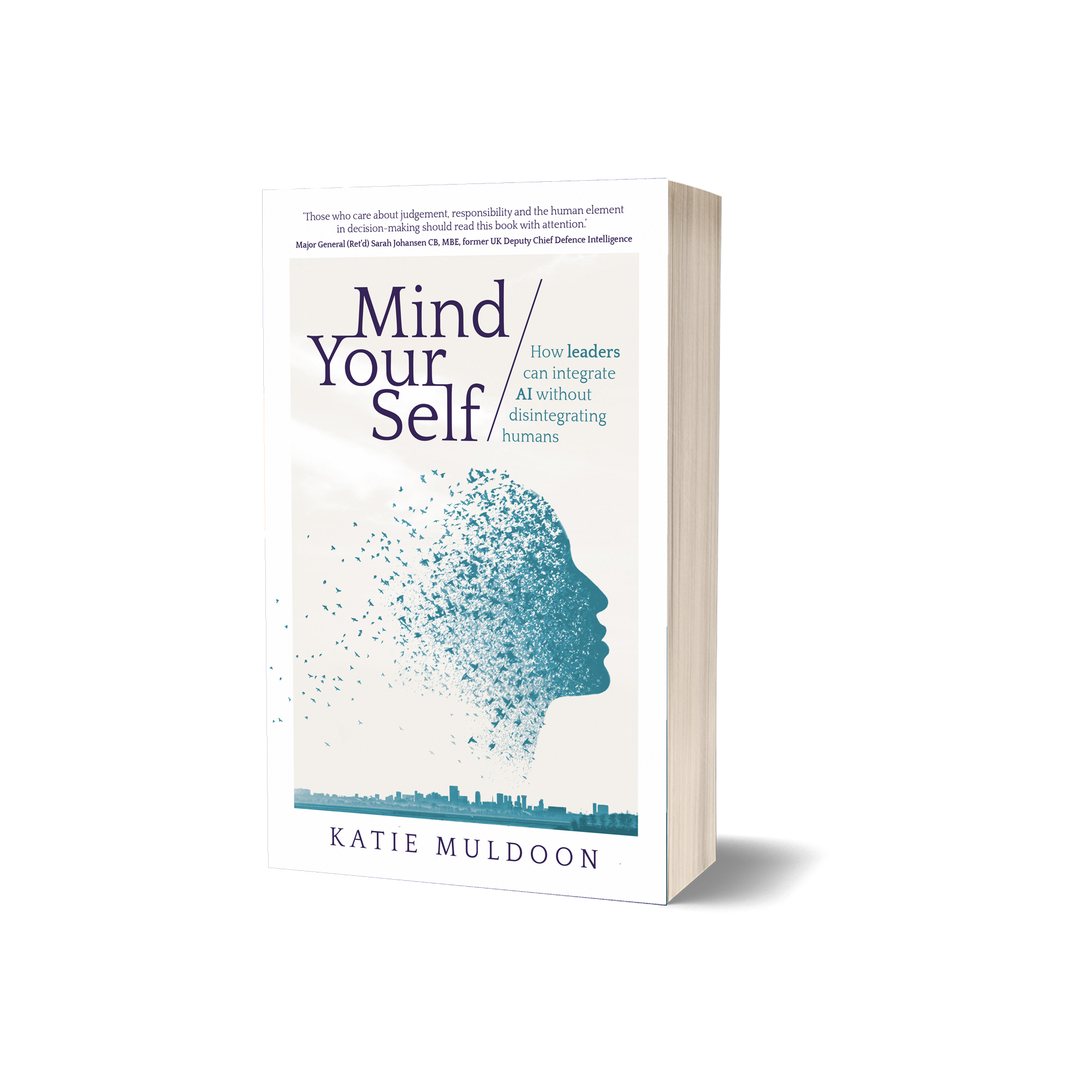
My career has taken me from RAF hangars in Afghanistan to clinical consulting rooms, innovation and conversations about technology and organisational change. At first glance, those worlds may appear to have very little in common.
But each one taught me something about how people respond when the stakes are high, and uncertainty is present.
In the military, I saw what helps people act under pressure.
In business, I saw how organisations wrestle with change, power and performance.
Through psychoanalytic training, I learnt to pay attention to what lies beneath the apparently rational story.
Mind Your Self brings those worlds together to explore what leadership demands in the age of AI.
Military experience and psychoanalytic training are laboratories for understanding human performance under pressure, for recognising the gap between intention and action, and for developing the metacognitive capacity to see systems, including oneself, clearly.
Military experience teaches the irreplaceable value of trust, preparation, and the ability to function collectively when stakes are high, and information is incomplete.
Psychoanalytic training teaches the art of noticing what is unconscious, of understanding how defences shape perception, and of creating the conditions where difficult truths can be spoken and heard.
Why does this matter in an age of AI?
These are not abstract skills. They are precisely the embodied capacities that leaders need when partnering with AI.
AI offers an apparent cut-through: accelerated learning without years of apprenticeship, creativity without the terror of the blank page.
But AI tools can simulate competence while masking incompetence, accelerate decision-making while obscuring decision quality, and connect us to information while disconnecting us from each other.
This is tempting for humans; shortcuts are evolutionarily designed into us to save energy. But an emergent property of this is that humans are also extraordinarily skilled at avoiding what they do not want to see, especially about themselves.
Defence mechanisms, such as denial, projection, and rationalisation, are not character flaws; they are universal features of human psychology. They serve important functions, protecting the ego from overwhelming anxiety or shame. But they also create blind spots that can be catastrophic in high-stakes environments.
Why does this matter for leaders in an age of AI?
The role of leaders, whether leading teams, organisations, communities, or families, is to dignify discomfort, to turn it into learning, and to protect the social practices that make growth possible.
Leadership in an AI world is, at heart, stewardship of human development under new conditions. It is the art of making choices about tools, norms, incentives, and rhythms that keep human capacities strong while harvesting the best of what machines can do.
Similarly, organisations that create space for productive conflict- disagreement about methods, creative tension between competing needs, honest examination of failures generate more meaning for their members than organisations that prioritise harmony over truth.
The vignettes in my book are case studies in how humans perform, and fail to perform, when technology, pressure and human psychology intersect.
The counterbalance is not abstinence from AI; it is wise, deliberate use.