When is an illusion not an illusion?
I’m going to invite you back to 2014, when I was in a meeting with colleagues at the end of a very long day.
We were a mixed group of people from different organisations receiving a verbal briefing. Part of the briefing covered what kind of aircraft were expected to operate in this region of the world.
My military colleagues read their briefing notes aloud. Faces in the room appeared to have a shared expression - ‘How was this possible?’
The presenters took each question at face value -
‘Have we seen this done before?’ - yes, for decades
‘Do we have a similar capability?’ - yes, absolutely
The room looked astounded. The presenters, baffled.
The confusion in the room was palpable, but we continued for a little while in this vein, until someone finally spoke to the bewilderment and said, ‘Just… just to be absolutely clear - what we’re observing isn’t real? Another country is using illusions?’
Suddenly the misunderstanding clicked into place. The presenters had been talking about “Ilyushins”, a Russian-made transport aircraft… not an astounding new capability!
What is the relevance of this story to leadership in an AI era?
You may think my point is illusions and confabulations! But the point I’m going to make is more human.
In groups, we regulate by seeking feedback through verbal and non-verbal communication. It took time before anyone in the group was willing to put words to the discomfort and confusion everyone felt. Initially, half the room thought they were hearing about a capability for the first time, while others were surprised that a transport aircraft had been received as something new.
But because the bewilderment was tangible - it had a felt sense even though no language was communicating it - someone eventually spoke up.
It’s already difficult to speak up in these situations. As we use AI more and more in professional contexts, we will be working with a capability that can deliver detailed work at pace. But it may make mistakes, or we may need to introduce human creativity and challenge into the process. Doing that requires us to use the skills of noticing the dissonance and naming the uncertainty in the room. It both becomes more crucial than ever before, and harder.
And it’s not something we do alone. We need others to challenge our assumptions, help us tolerate uncertainty and notice what we cannot see alone. AI can provide an immediate answer, but it cannot participate in all the non-verbal communication and contact that lets us, as humans, navigate toward shared wisdom.
One of the most important tasks for leaders will therefore be to protect the spaces in which people can think together, particularly when turning to a machine would be quicker and more comfortable.
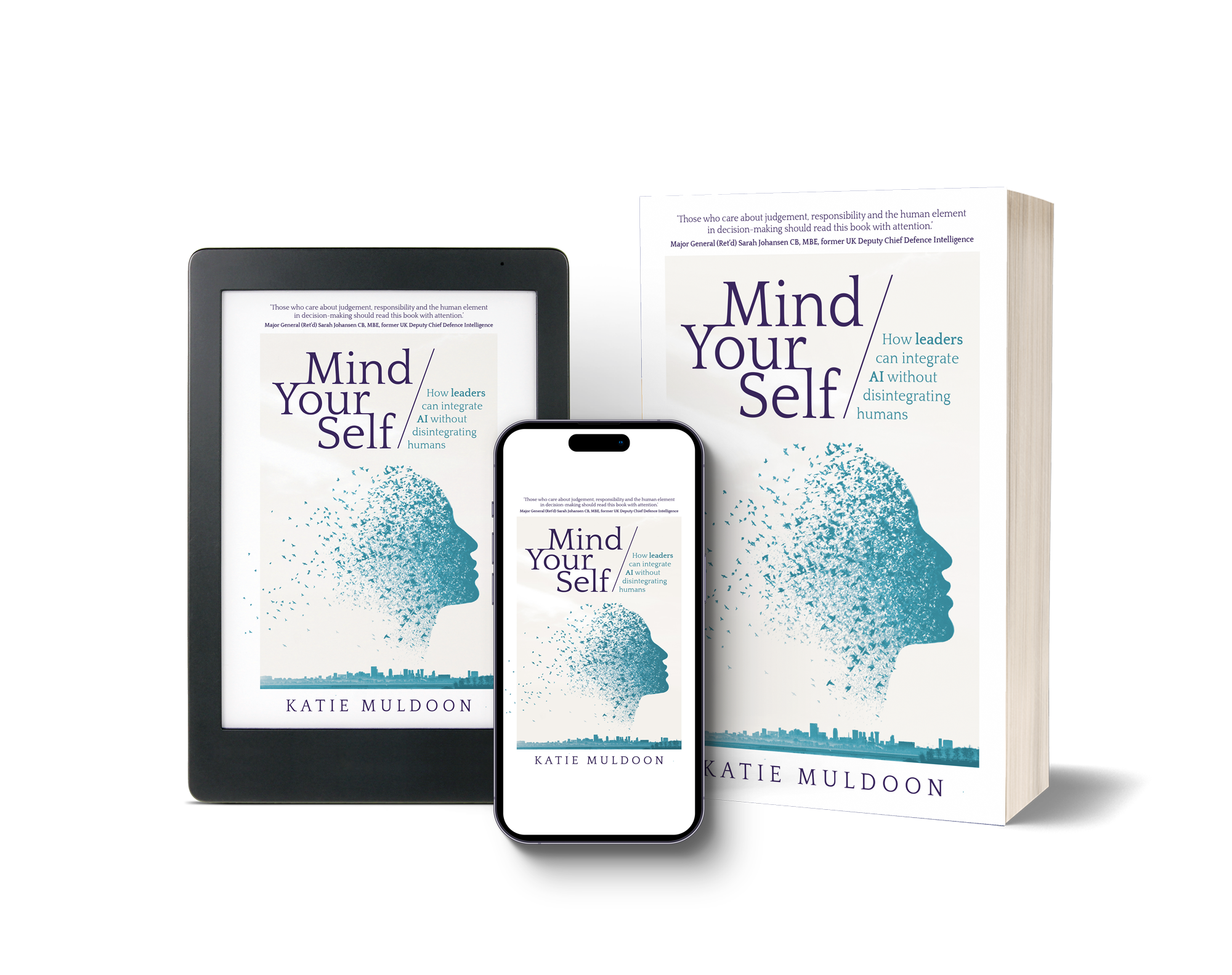
This is one of the themes I write about in my book
My book is the culmination of a career spanning military service, innovation consulting and psychoanalytic training. I reveal how leaders can protect the human capacity to feel, think, and choose as technology accelerates, in the moments that most demand it.